
Consider kits instead of individual components
I recently finished building a high-voltage power supply for my home lab and needed a number of new parts I did not already have on hand. Many of the parts I ordered from Mouser and Digikey including the LR8 voltage regulators, high-voltage MOFETs, the heat sinks, several high-voltage capacitors, and 100 1N4007 rectifier diodes. [1] However, there are often parts where I am unsure of what value I will need or that I might use similar but not identical parts in future projects. For this latter category of items a kit of parts might make more sense because I can get an assortment of similar items at a relatively small cost to test in my circuit and stock in my lab.
For example, for the high-voltage power supply I was unsure if a linear or logarithmic potentiometer would give a more natural feel for adjusting the voltage. Rather than buy a few select values, I found this potentiometer assortment for $26 that pretty much covers any one-turn pot I would ever need. In addition, distributors like Digikey and Mouser require you to buy the potentiometer and knob separately, whereas the kit includes both (as well as washers, nuts and dust seals). It even includes a nut driver to tighten the potentiometer to a panel.
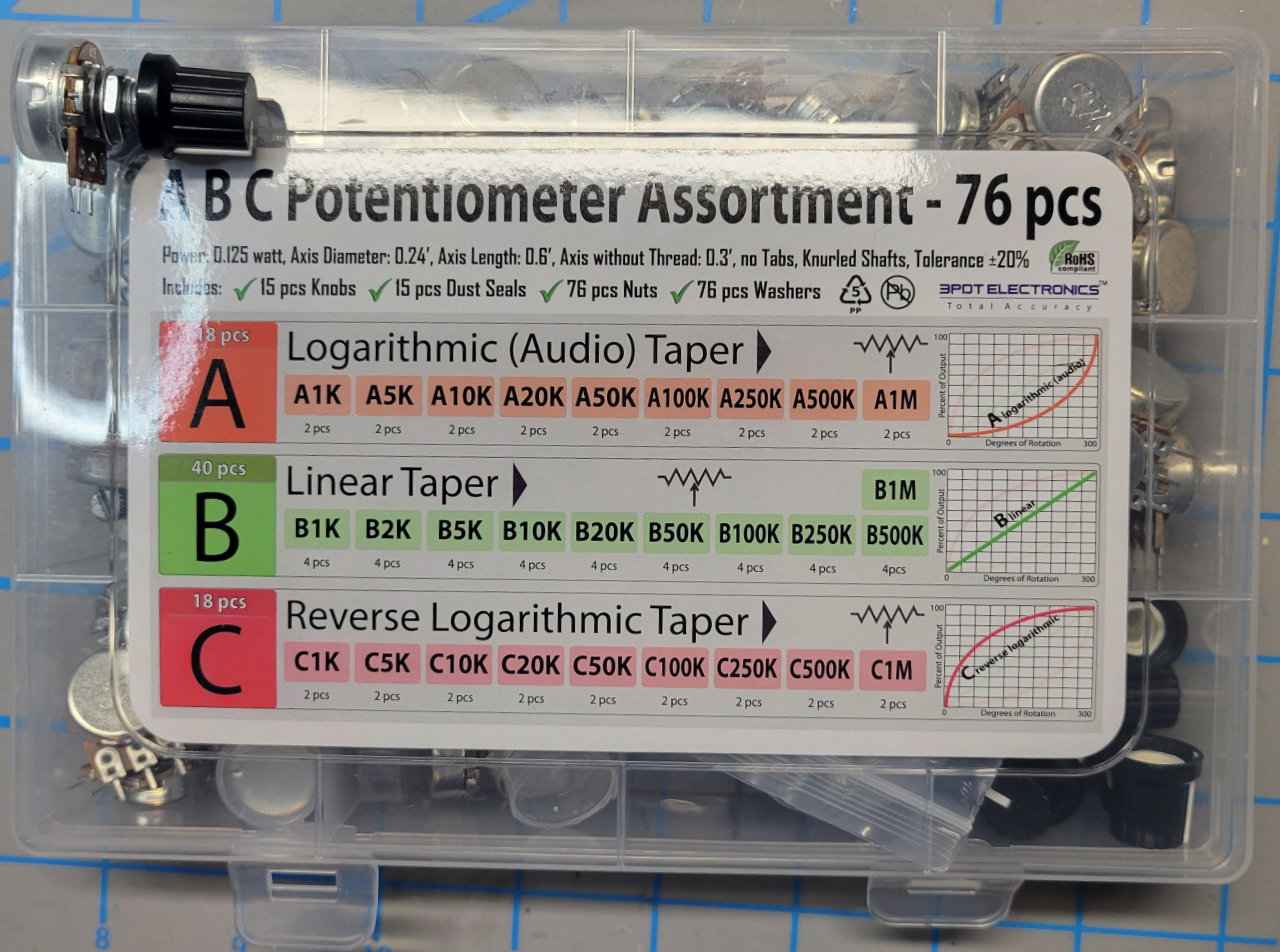
Logarithmic, linear, and reverse log potentiometer assortment
Another type of useful kit is for connectors. Buying individual connectors makes little sense if you plan to use similar connectors in other projects. For the power supply, I bought a kit of screw terminal blocks, a kit for plugging wires into 0.1″ headers, and one for the front panel output jacks in multiple colors, each for less than $10. [2]
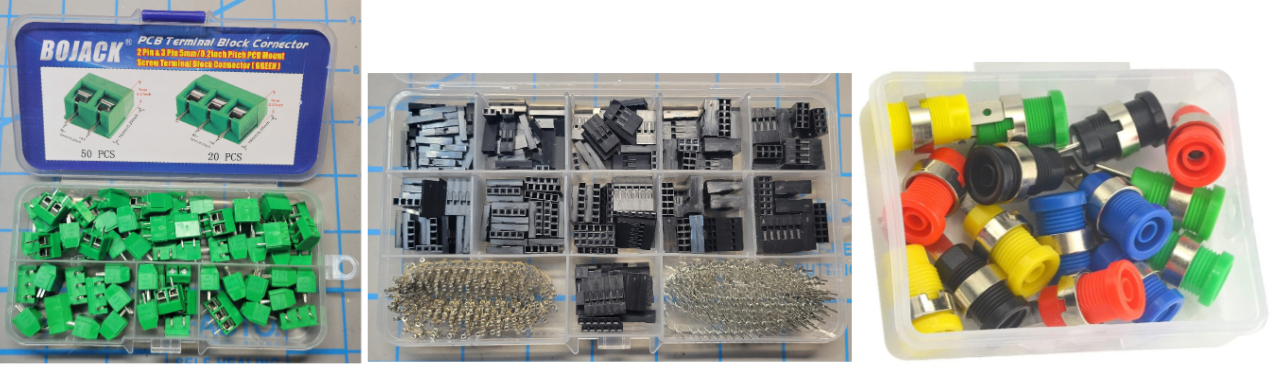
Examples of connector kits
I also bought kits for hardware including a kit of 2mm, 3mm, and 4mm screws with washers and nuts at Microcenter and a kit of #6 screws with washers and nuts.
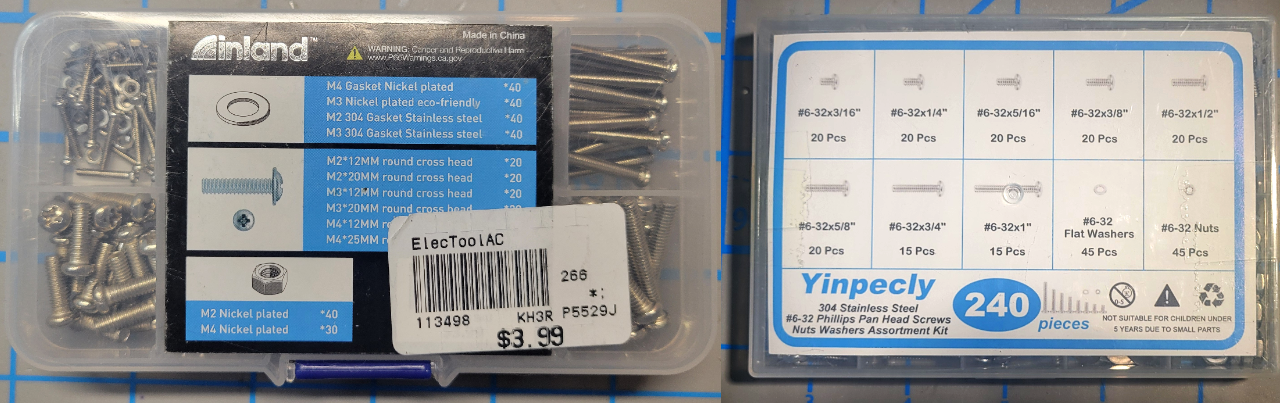
Metric and #6 machine screw kits
I started testing the high-voltage power supply with several 1W resistors in series but I finally broke down a bought a kit of 10W resistors which made testing much easier. I also bought a kit of 34 different 500mW zener values, sure to last me a lifetime. (With semiconductors you could be buying parts that do not meet specifications but I will test them before I use one to make sure they are what they say they are.) I bought a kit of 1W resistors and high-voltage capacitors for the project as well.
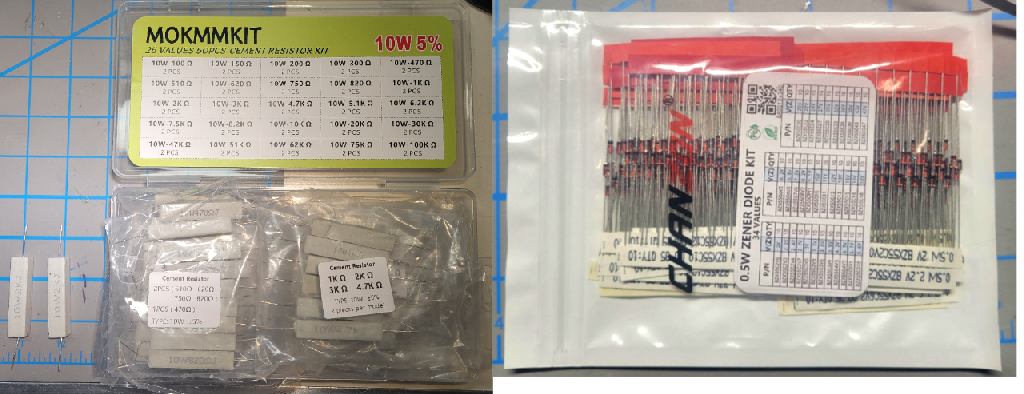
10W power resistor kit and zener diode kit
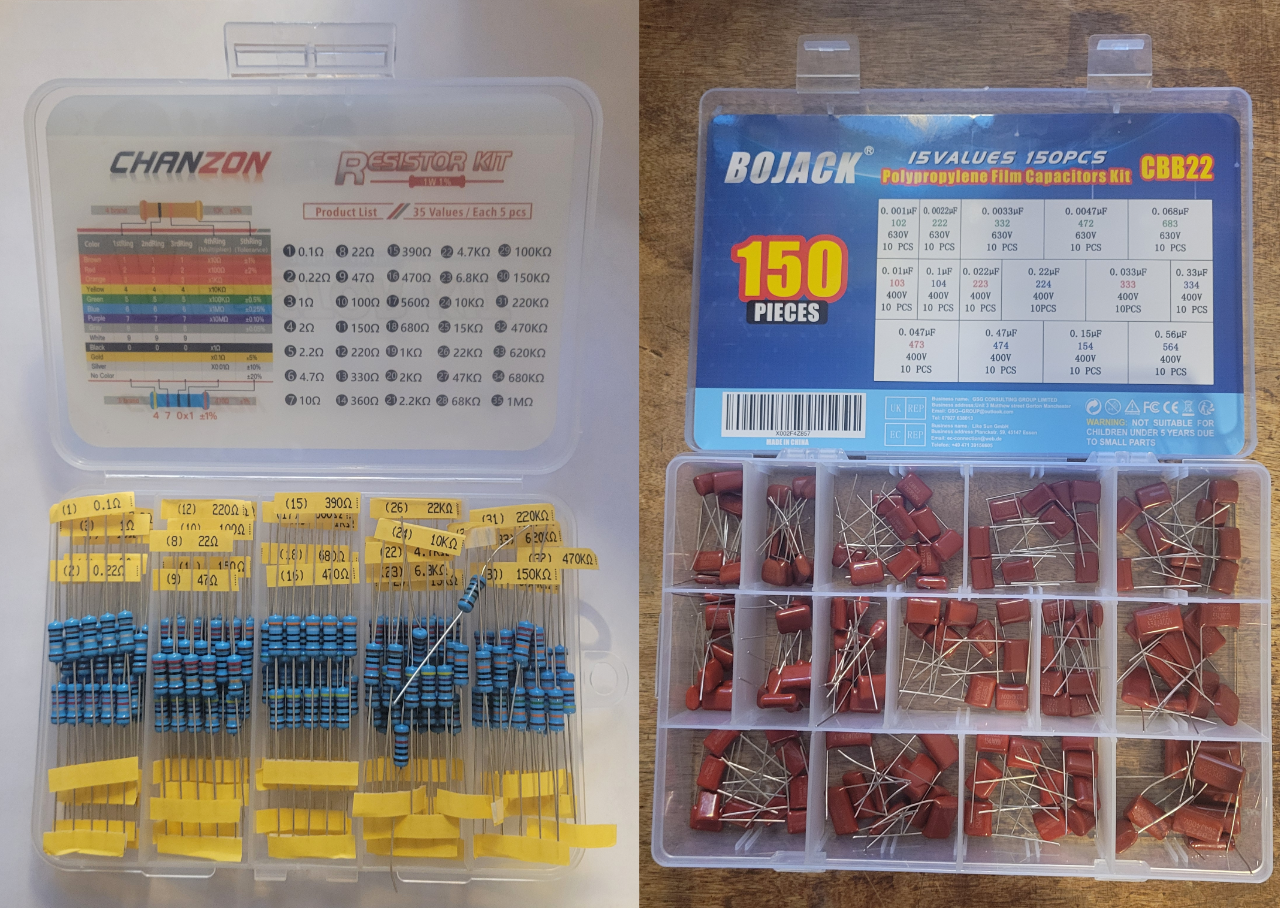
1W resistor and high-voltage capacitor kit
Kits work for simple components such as resistors, hardware, connectors, etc. but not all kits are great. I bought a kit of 10 panel LED lights in different colors for $9 that seemed like a better deal than buying individual lights from Digikey at $4 each. Unfortunately, while the lights in the kit looked like the ones at Digikey, they were poorly made, the crimped-on leads fell off and the LEDs were not glued into the housing so they canted when installed in the panel. I gave up and ordered two of the more expensive ones for my project.
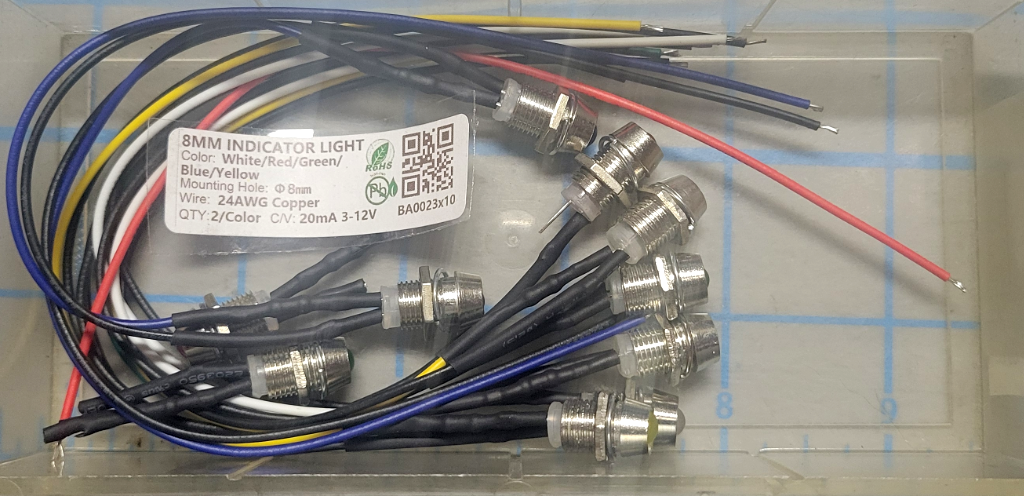
Cheap, poorly made kit of LED panel lights
Similarly, I ordered a set of cord strain reliefs from Amazon but they were sort of inelegant (they would have worked fine) so I bought the more expensive one Paul Horowitz recommended at Digikey.
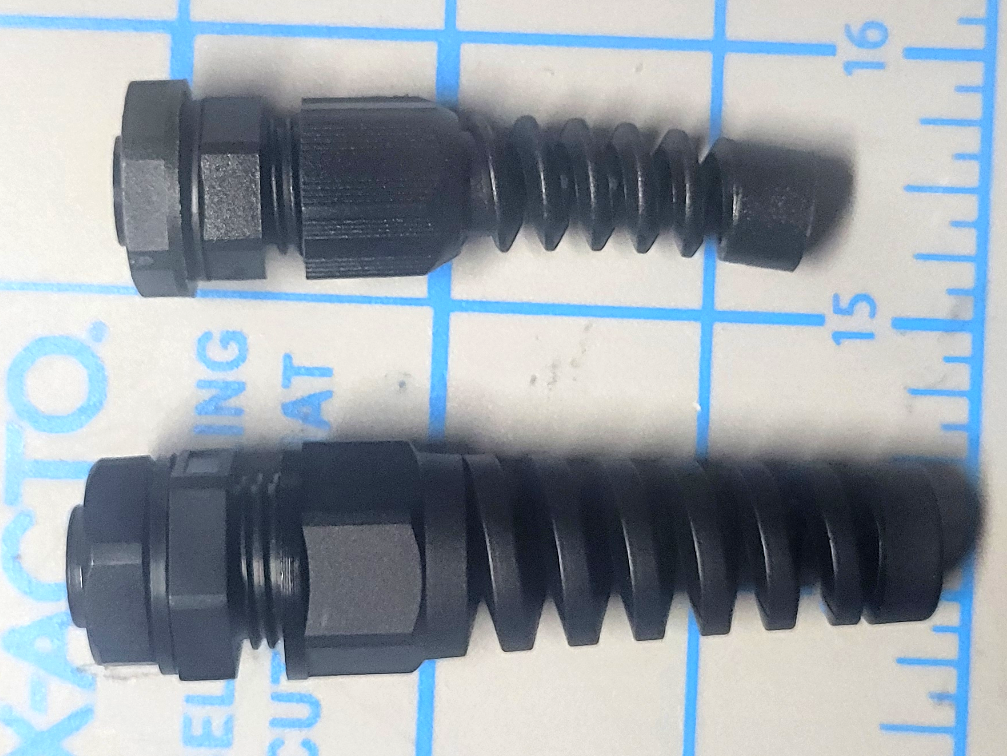
Strain relief cord connectors. I didn’t like the size of the cheaper one on the bottom
Here are some additional kits I bought before the high-voltage power supply project.
The book uses uses 5% resistors with only a few exceptions (e.g., Lab 7L.4) because we want our students to think about component tolerance in their designs. One percent resistors make it too easy to forget that components may not be the exact value printed on them. For that reason I also use 5% resistors in my designs except where a higher precision part is necessary to make the circuit work. I bought this kit of 1% resistors for those occasions. (Obviously there are many more 1% values than contained in this kit but with good design I can usually make one of these values work.)
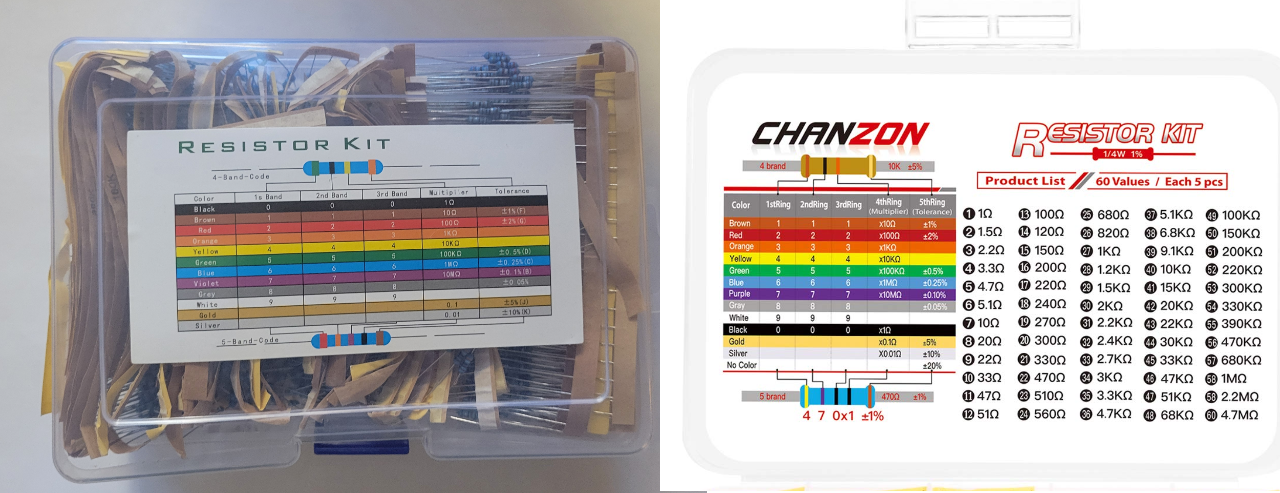
1%, 1/4W resistor kit
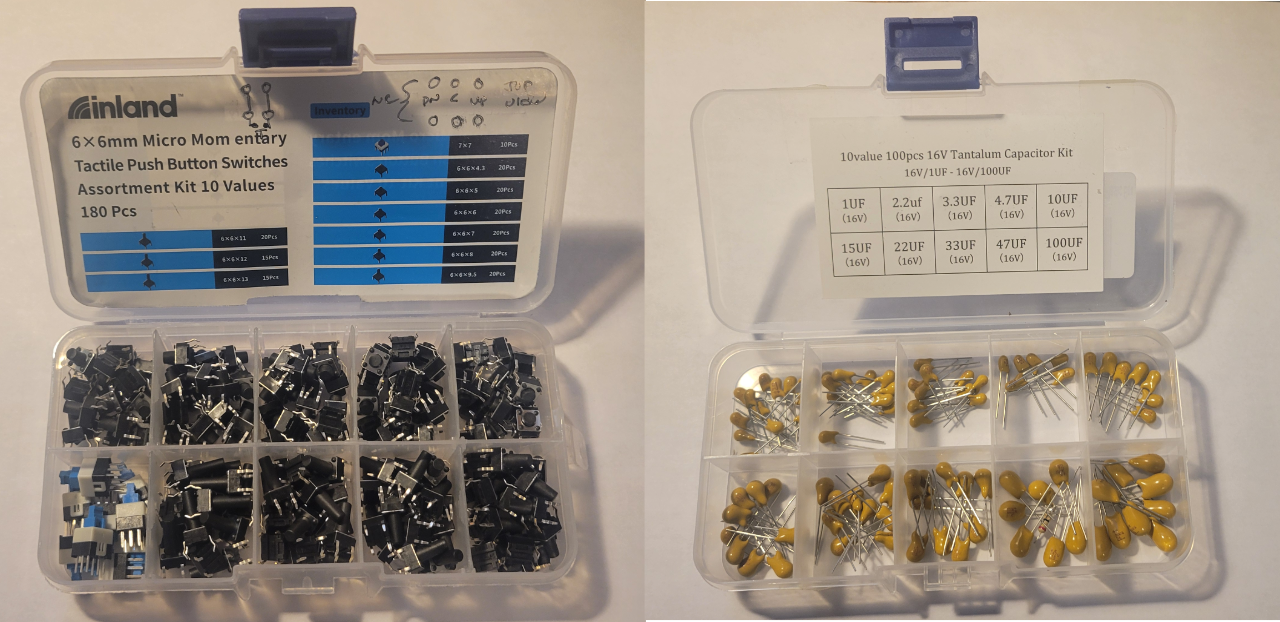
Pushbutton switch and tantalum capacitor kits
[1] The 1N400X series of 1A rectifier diodes comes in increasing max reverse breakdown voltage from 50V for the 1N4001 to 1000V for the 1N4007. A hundred of the 1N4001 costs about $5 while 100 of the 1N4007 costs about $7 so it really doesn’t make sense to stock anything but the 1N4007.
[2] I have mixed feelings about the output banana jack kit. On one hand they look great and allow you to plug in hooded banana plugs like the ones on multimeter leads. This is great for this application which has dangerous voltage on the high-voltage output. The problem is the design makes it hard to solder. The large, thick metal tail takes so long to heat up to get a good solder joint that the plastic housing starts to deform. I destroyed two before I realized you have to plug in a hooded banana jack while you solder to keep the plastic intact until it cools. These would be much better if the solder tail was much narrower so it could heat up quickly to solder. I will probably use a Dremel tool to isolate the tab before using them again.