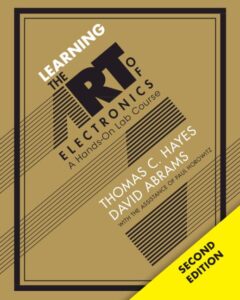
Do I need to buy The Art of Electronics and what about parts kits?
A reader asked:
I have 2 questions about the book. I was looking on the LAoE website and it said that it’s a companion book to the book “The art of electronics”. Does this mean that I need to get both books? I have the LAoE already but not the “The art of electronics”. Since I don’t have a background in electronics I just want to make sure that I’m getting everything. My second question is about the parts list. I’ve noticed that its quite extensive and it requires getting parts from multiple websites and vendors, what I’d like to know is would a electronics kit with different electronic parts be acceptable or do I need to get the exact parts listed in the parts list?
My reply:
You do not have to buy The Art of Electronics, nor should you as a beginner. AoE is a reference compendium of electronic devices and circuits while LAoE is a set of labs to try those circuits and devices out. But LAoE is complete itself; it explains the devices and circuits it uses so you do not need any additional texts. Once you are familiar with the contents of LAoE you might consider AoE if you want more depth or more complexity. We have included notations in LAoE to particular sections of AoE for people who have both or want more information but you can just ignore those.
We have tried to get as many parts as possible from a single source (Digikey) but some items either were out of stock when we made up the parts list (you might want to check again when you put together an order) or are only available elsewhere (the FPGA for example). Electronics kits for the capacitors and resistors should work fine (although most resistor kits don’t include parts over 1M Ohm – check to be sure since a few labs use a 10M resistor) and general kits may include op amps and transistors that can be substituted but we haven’t tested them and as a beginner it may be difficult to tell if something is similar enough to work.
On the other hand, you don’t have to do every experiment/lab in the book or at least not all at once. For example, you might want to do the digital chapters 14 through 19 first so you only need those parts to start (and with only a few exceptions the parts in the digital parts list all are available from Digikey). I taught the second half of the book remotely during COVID and had to send parts kits to my students and it was not an unreasonable number of items. Many of the oddball parts are only used in one or two labs so you can skip those if you don’t have the part (see High Cost Parts).
Read MoreWhy are there two columns for prices in the parts list?
A reader was confused by the two price columns in the parts lists. He was unsure which applied to a hobbyist wanting to do the experiments in the book.
I replied:
There are two price columns for almost every part on each Parts List. The first is the single quantity price (“Price (Qty 1) $US”) which you need to multiply by the “Qty Needed” column value to see how many you need to buy and what it will cost for a single person to do the labs. The “Qty Price $US” and “Qty” (which is the number of parts you get for the listed Qty Price) columns are for institutions equipping a lab for multiple students who plan to buy in quantity for teaching the book as a course to large number of students.
For example, the first item on the Analog Parts list is the 6.3V Transformer which cost $11.72 for a single purchase in Feb 2025. You only need one of these to do the labs that require it. However, a university lab such as the one I taught in is not going to buy just one, rather they might choose to buy 25 of them for $253.29, thus saving a bit under $40.
You can also save money by excluding some higher cost parts that are only used in one or two labs. For example, the LTC1150 op amp is $12.52 but is only used in a single lab in Chapter 7L. Another reader asked which items these are and we have now published a list to help you decide which (if any) of the more expensive parts you may not want to purchase by skipping the lab or labs that use it.
Read MoreA reader asked if he could skip purchasing some of the more expensive parts
A reader asked: “The parts lists are essential resources, thank you for making them available. It would be very helpful for planning purposes if the lists also identified which labs use the less routine and more expensive parts (as you already do in some cases), especially for hobbyists such as myself.”
In response, I added a page to the web site listing the more expensive parts and where they are used. I also discuss which of them you can consider skipping to save some money and which are more important.
https://learningtheartofelectronics.com/about-the-book/parts-lists/high-cost-parts/
Read MoreSome advice on buying an oscilloscope
A reader asked what “[w]hat would be a good [oscilloscope] (hopefully economical) that would be able to handle your course and build my own headphone amplifier/preamp and “stomp boxes” for an electric guitar? What do I need to consider when purchasing a capable, reliable oscilloscope? Is there a particularly good place to purchase one?”
Here is my answer:
There is some information on oscilloscopes in the online chapter:
https://laoe.link/appendix/Appendix_F_Equipment.pdf
but ultimately it depends on your budget and needs. The audio devices you list do not require an expensive oscilloscope. Nor are they likely to require more than two channels (a few of the experiments in the book are easier to debug and understand with a four-channel scope). You can get a very inexpensive two-channel scope suitable for audio work for under $100 (some as low as $38 – https://www.amazon.com/FNIRSI-DSO-510-Oscilloscope-Generator-Automotive/dp/B0DJX6W58S/ – 10MHz is adequate for audio work):
https://www.amazon.com/s?k=oscilloscope
These are hand-held, with a small display but should be sufficient if your budget is limited. (I have no personal experience with them so I cannot recommend a particular unit.) Cheaper handheld scopes are usually limited in bandwidth and may be limited in sensitivity (the smallest voltage signal they can display) so it depends on if you want to look at something like the output of a guitar pickup (a very low voltage) or not.
Moving up, you probably want at a minimum a 100Mhz scope for the digital half of the book and to see the parasitic oscillations discussed in Chapter 9. I am familiar with Siglent scopes (I bought a dozen of the 2000 series for my lab at Harvard ). This 1000 series, 4-channel, 100MHz scope for $500 is a very capable scope that should get you through all the experiments in the book.
https://www.amazon.com/Siglent-SDS1104X-oscilloscope-channels-standard/dp/B0771N1ZF9/
You can also get a two-channel scope for less from other vendors, but I am unfamiliar with the brands or their products.
https://www.amazon.com/Hantek-DSO2D15-Digital-Storage-Oscilloscope/dp/B08MDSG839/ ($225 for 2 channels, 150Mhz)
https://www.amazon.com/FNIRSI-1014D-Dual-Channel-Oscilloscope-Generator-Bandwidth/dp/B097T5NRTZ/ ($180 for two channels, 100Mhz)
https://www.amazon.com/HANMATEK-Bandwidth-Oscilloscope-Channels-Professional/dp/B0833YFNKP ($170 for two channels; $240 for four channels, 100Mhz/110Mhz)
These include a built-in signal generator (which tend to be limited in amplitude but could be adequate for what you are doing).
All of these are incredibly powerful tools at prices an order of magnitude less than what was available when analog scopes ruled the earth.
I like Amazon because I have Prime so shipping is free and they are very generous with returns, but you may be able to find them elsewhere for less. You might want to make a decision soon because when stock runs out the next batch will probably cost more due to Trump’s tariffs on China (most likely all of the scopes listed above come from there).
Links and prices as of May 2025
Update 2025-05-16
The latest bonus edition of Elektor (free to download) has a review of one of the low-cost ($85 at Amazon) hand-held scopes on p22.
https://www.elektormagazine.com/files/attachment/61810
Read MoreLearning the Art of Electronics, 2nd Ed is shipping
March 20, 2025 – Amazon is now shipping the second edition of LAoE, promising delivery in about a week.
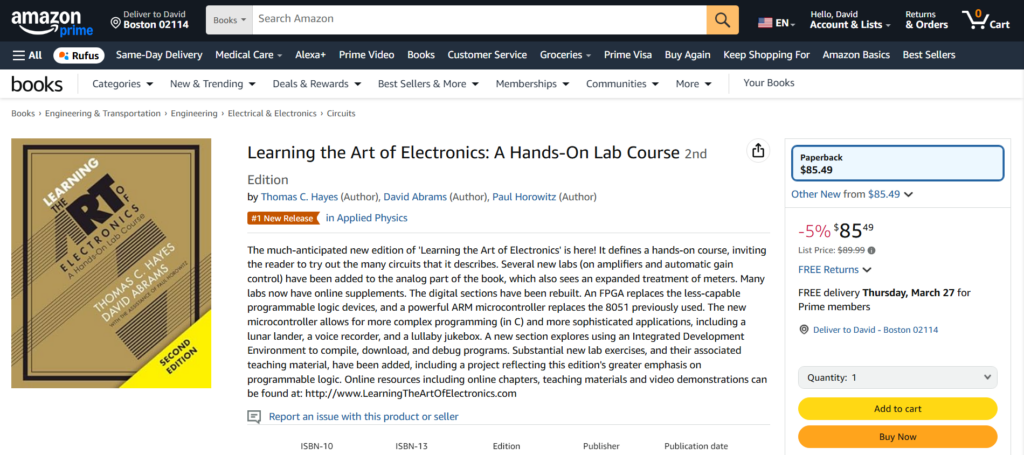
Expected Arrival
The Second Edition of Learning the Art of Electronics is expected to available in early March 2025. Pre-orders from the various vendors should commence soon thereafter (the books have to be shipped, un-packed, stocked, etc.)