
Substitutes for the DG403 analog switch
The DG403DJ quad analog switch used in chapter 10 and 12 of Learning the Art of Electronics is getting harder to find. It has been replaced by the DG403DJ+ which is much more expensive ($5 USD vs $30 USD).[1] Both versions of the DG403 include four electronic (MOSFET) analog switches controlled by two independent control inputs. Each input controls one pair of switches, one that is normally open (i.e., open when the control input is zero volts) and one that is normally closed. That means the state of the two switches controlled by each input will always be opposite of each other. The S[1-4] and D[1-4] are the switch connections and either the S or D may be used as input or output, the switch is symmetrical. In several of the labs, either the inputs or outputs of the complementary switches are connected together to form a SPDT configuration.
The analog supply inputs V+ and V- are connected to +15V and -15V respectively. The VL supply powers the digital logic that controls the switch and is connected to +5V.
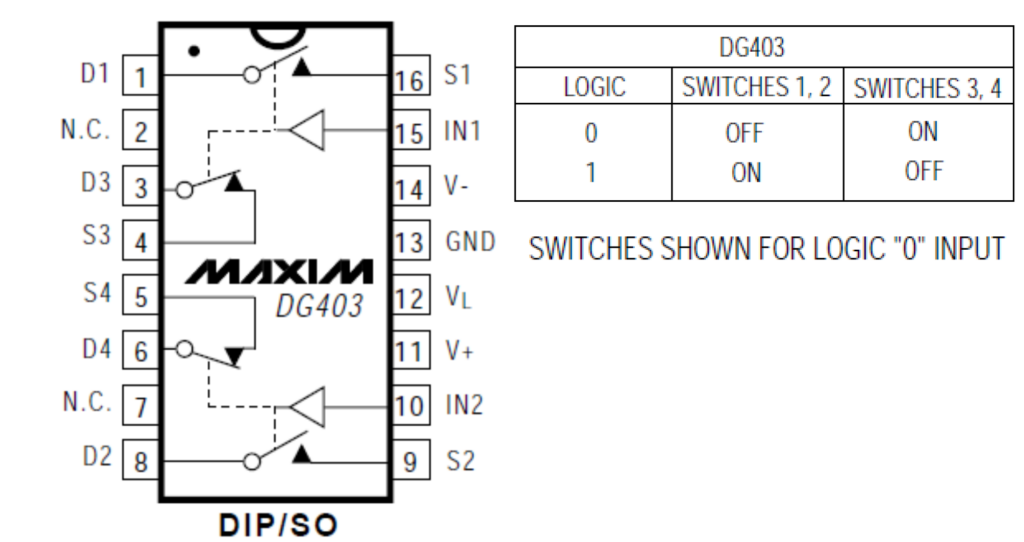
Internal configuration of the DG403 analog switch. Each “IN” input sets the state of a pair of analog switches. Logic level “0” is IN <= 0.8V and logic level 1 is IN >= 2.4V for VL = 5V.
Digikey still has (as of June 2026) 350 in stock at $4.47 each but once those are sold they will not be re-stocking them. Mouser only has the DG403+ available for $30.16. The DG403DY in a SOIC-16 package is available for $4.26 from Digikey or $1.62 from Mouser but requires an SOIC-to-DIP adapter and some adroit soldering skills. The through hole version is still available on eBay but shipping charges make it not much cheaper than the plus version.
DG403 replacement using a DG413 quad SPST analog switch
The Renesas DG413 quad analog switch ($3.31 at Mouser or $3.23 at Newark) is almost a direct replacement for the DG403. It also has two normally open analog switches and two that are normally closed. The primary difference is that each switch has a separate control input rather than having two opposite input polarity switches connected to a single control input. Here is how you can connect the DG413 so it mimics the DG403:
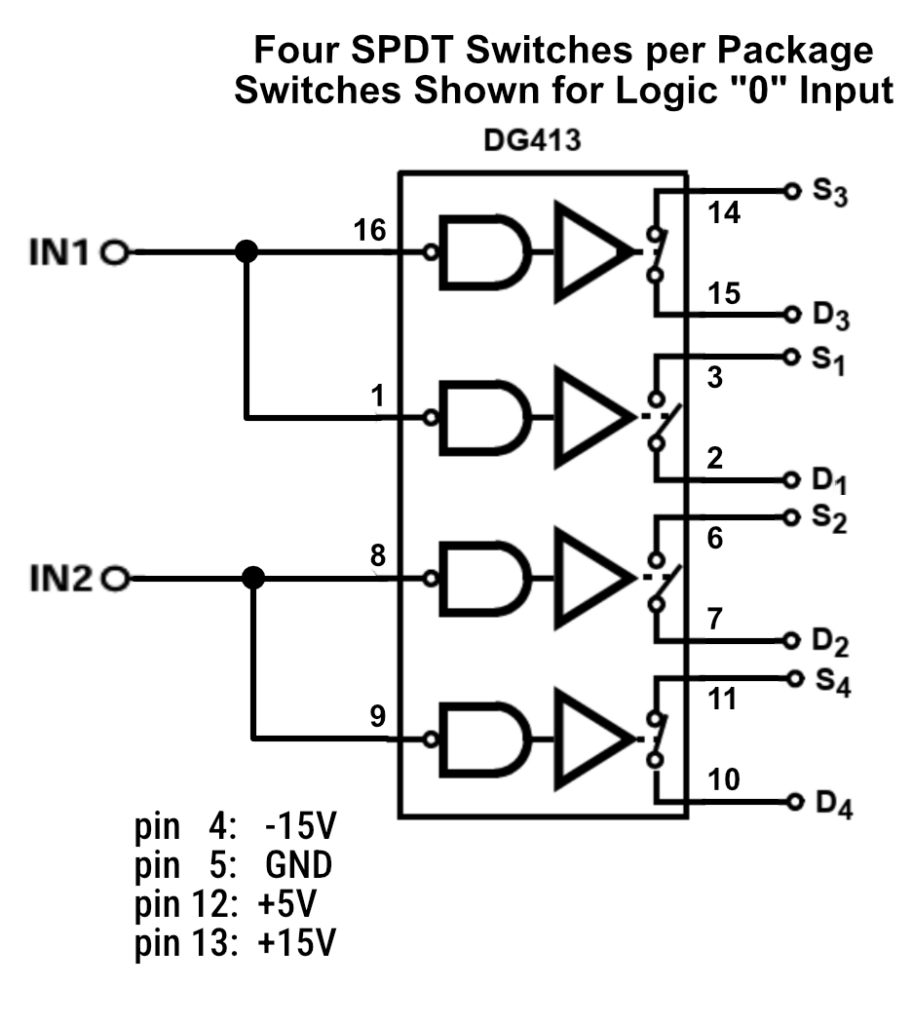
DG413 analog switch configured to mimic the DG403. The pin numbers are for the DG413 but the pin functional labels match the DG403.
The DG413 has lower charge injection than the original DG403 ( 60pC typ for the original Harris DG403, 10pC typ for the improved Maxim DG403, and 25pC typ for the DG413) so it may be more difficult to see the effect of charge injection on the sample & hold unless you use a smaller hold capacitor. (Note: The original Intersil DG413 had 100pC typical charge injection so if you get ahold of one of those the voltage jump will be very easy to see.) The DG413 is considered an obsolete part and may not be available at a particular distributor once its stock is exhausted. See Octapart.com for alternative suppliers.
DG403 replacement using a DG441 or ADG441 quad SPST analog switch and two digital inverters
You can build the equivalent of the DG403 from a DG441 quad SPST analog switch ($2.42 at Mouser or $1.98 from Arrow) or the ADG441 (an enhanced version of the DG403, $4.52 from Digikey or Mouser) and the 74HC14 Schmidt trigger inverter on the analog parts or the 74HC04 digital inverter (on the digital parts list – $0.26 at DigiKey, $0.55 at Mouser). A digital inverter takes a low digital signal (~0V) and converts it to a high signal (~5V when used with the [A]DG441) and visa versa. Note that the 74HC14 Schmidt trigger inverter is pin compatible with the 74HC04. Either will work in this application.
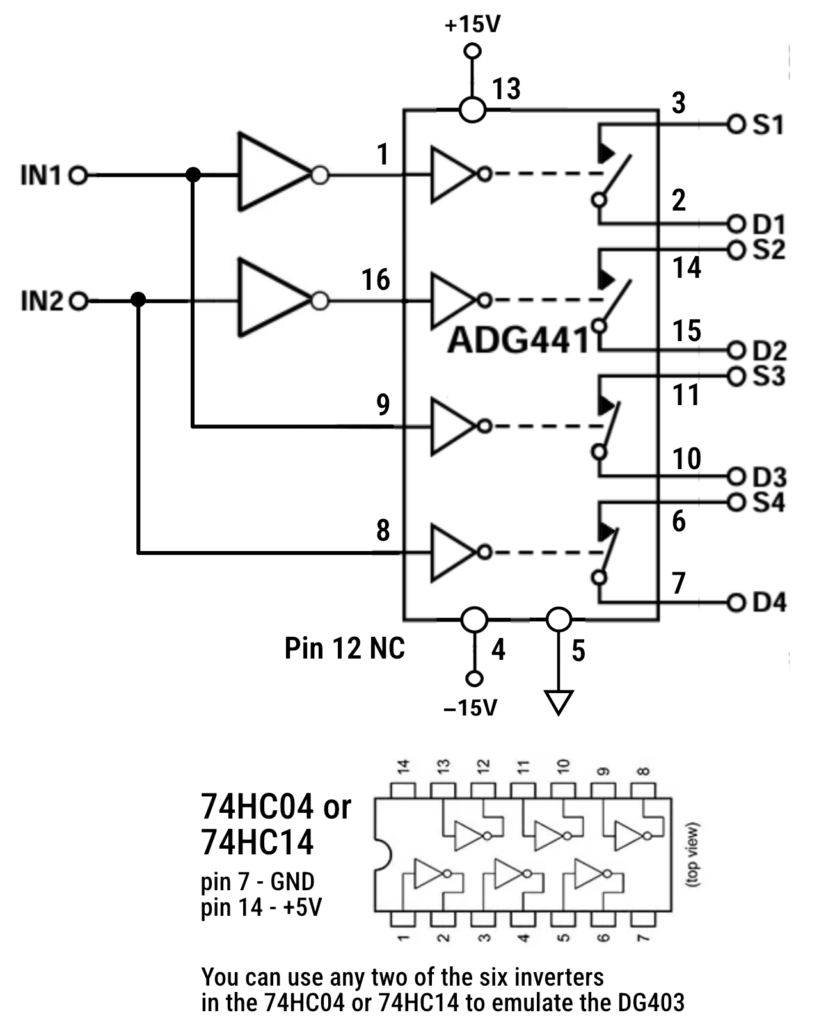
DG403 replacement using an ADG441 and two digital inverters.
The DG441/ADG441 creates the logic voltage (VL) internally, so no +5V connection is required (however the 74HC04/14 does require a +5V supply). The primary disadvantages of this circuit over the DG403 are that it is a bit more complicated (two devices instead of one) and the charge injection specification of the ADG441 is very low, 6pC typical — about 10 times less than the original DG403. This sounds like a good thing (and it is if you are using it in a real circuit) but it makes it hard to see the effect of charge injection in lab 12L.2.2.[2]
DG403 replacement using one or two DG419 or ADG419 SPDT analog switches
The DG419 is a single SPDT MOSFET analog switch in an 8-pin DIP package. You can think of it as one-half of the DG403 with the D connections of the two switches that are controlled by the same IN pin connected together.
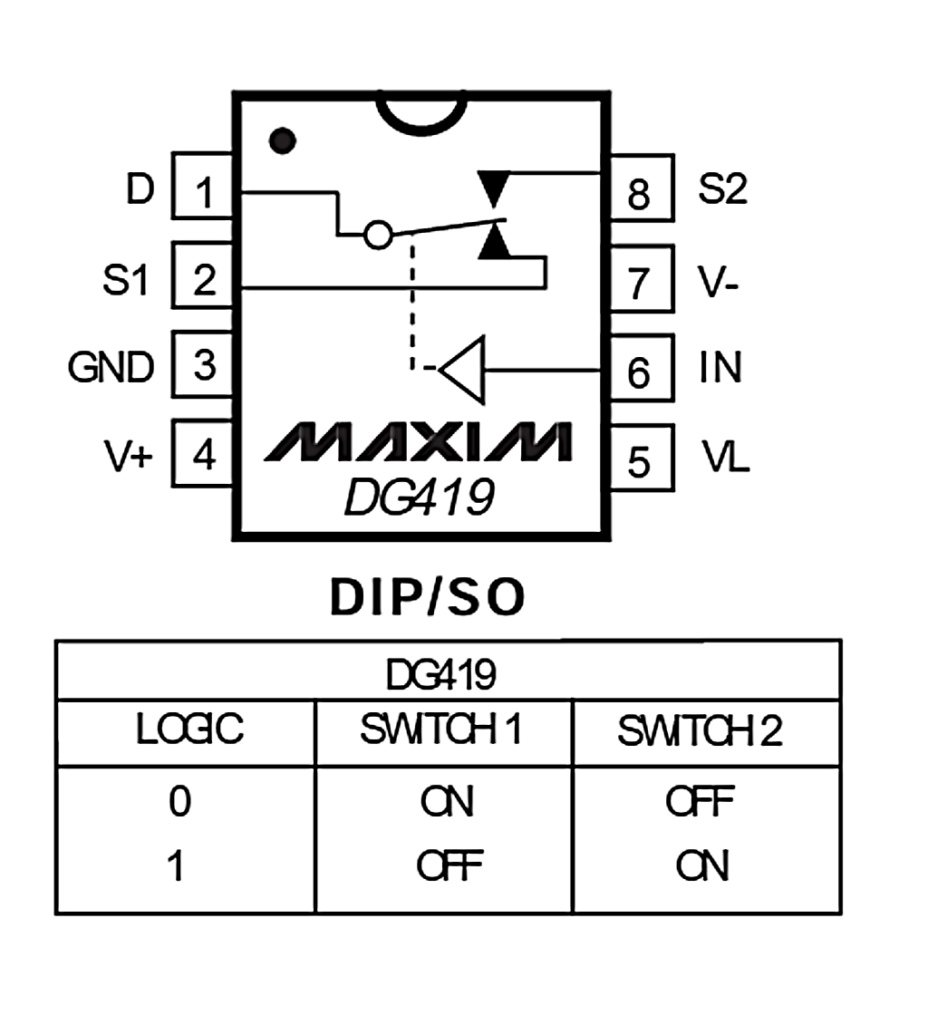
DG419 analog switch pin configuration.
The ADG419 is an improved version of the DG419 similar to the DG403+. The ADG419 is available from DigiKey for $6.16 and from Mouser for $5.99 but the plain DG419 appears to be available for less than $2 from other sources. We bought five of them on eBay for $15.57 shipped. The specifications for the DG419 are very similar to the DG403 while the ADG419 has improved performance including much lower charge injection (3pC typ, 10pC max vs 60pC typ for the DG419). As with the ADG411, the lower value will make it more difficult to see the error caused by charge injection in the sample & hold unless you use a very small sample capacitor.
A single DG419 is adequate to perform every experiment in LAoE that uses the DG403 except the flying inverter of Figure 12L.12, which requires two DG419s. If you choose to skip the flying inverter, you can get away learning about analog switches pretty cheaply.
All prices in $US as of June 2026.
[1] The plus version of the DG403 has lower on resistance and charge injection which is better if you are using it in a real-world circuit but worse in the LAoE labs because it makes it more difficult to see and measure the errors caused by switch imperfections such as charge injection. See image below and LAoE sections 12N.6.7 and 12N.7. Unfortunately, the ADG441 and the ADG419 also have very low charge injection so you may have difficulty seeing the effect on the sample & hold unless you use a very small hold capacitor.
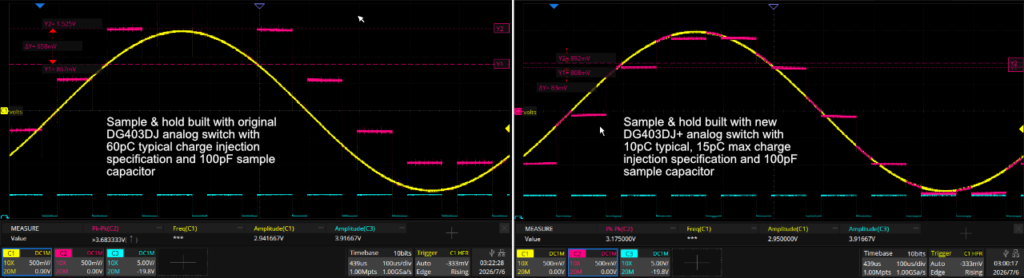
Comparison of the original DG403DJ and the improved DG403DJ+ showing the effect of the much smaller charge injection specification on the newer part. Charge injection causes a 658mV jump in the storage capacitor voltage when the switch opens in the original part while it only causes a 83mV jump in the improved part.
[2] The charge injection specification for the ADG441 is 6pC max. The effect of charge injected on our test of the ADG441 with a 100pF sample & hold capacitor was invisible on the scope trace. We replaced the the sample capacitor with a 15pF cap and saw about a 200mV jump implying about 3pC of injected charge, which was visible.
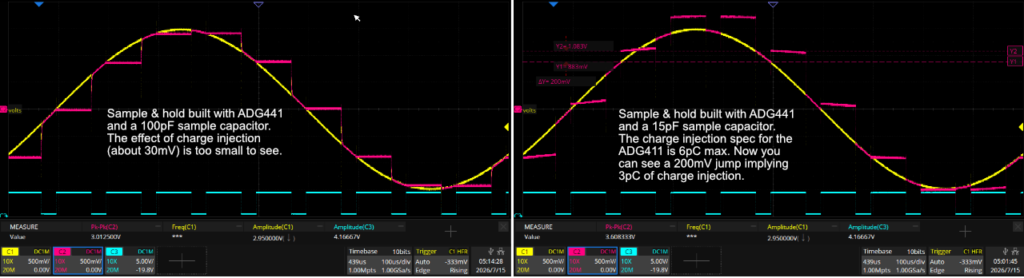
Comparison of the effect of charge injection in a sample & hold built with the ADG441 and a 100pF sample capacitor (left) and a 15pF sample capacitor (right).