
Why does LAoE use 5% resistors when 1% costs the same?
All electronic components have tolerance — the maximum deviation you can expect around its nominal value. When I started in electronics, the cheapest resistors were carbon comp[osition] spec’ed at +/-20%, meaning a 1K resistor could be anywhere between 800 Ohms and 1.2K. Over time, as manufacturing process improved, 20% and 10% resistors gave way to 5% as the standard tolerance, with 1% resistors costing more. Nowadays, 5% resistors are less common since 1% resistors are no more expensive.
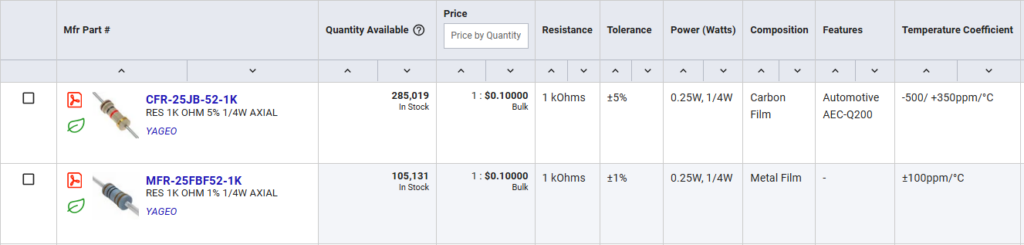
A search for a 1K, 1/4W resistor at DigiKey shows identical pricing.
Not only does the 1% resistor cost the same as the 5% part, it is more accurate and has a lower temperature coefficient.[1] So why does Learning the Art of Electronics insist on using 5% resistors (except for the instrumentation amplifier in lab 7L.4)?
The answer is pedagogical. Our goal in LAoE is to give you a firm foundation in electronic circuit design to allow you to create your own projects in the future. One of the issues you need to consider when designing circuits is how important is the tolerance of a component. Sometimes the actual value of a resistor is relatively unimportant (say when used as a pullup as in Figure 16L.6). In other cases the tolerance matters, such as in an RC oscillator; see lab 8L.5. If we let you use 1% resistors in the LAoE labs, you would rarely have to even think about tolerance — but we want you to start building good design habits now.
In addition, standard resistor values are designed to have the upper tolerance of the lower value just meet the lower tolerance of the next higher value. Thus standard 5% values go in a 1.0, 1.1, 1.2, 1.3, 1.5, etc. sequence of 24 values per decade while there are 96 values per decade for the standard 1% resistors. Since you are less likely to have the exact 5% value you want when you calculate the value for a voltage divider or an RC oscillator, we want you to get used to deciding how important an exact value is. If you need a more exact value you need to use a 1% (or even tighter tolerance) resistor. Judgement is an important skill in creating good circuits.[2]
[1] Temperature coefficient is the change in a component’s value with a change in temperature. In a high precision application, a device or circuit may be placed in a temperature stabilized enclosure (an “oven”) to minimize variation with environmental temperature. This technique is often used in precision crystal oscillators. See e.g., https://en.wikipedia.org/wiki/Crystal_oven
[2] In our class, students invariably want to create a more exact value by paralleling or using a series connection of two 5% values. We warn students that is is not acceptable. If they need a more exact value they should use a 1% resistor, but the experiments in the book (with the exception of the instrumentation amplifier) are designed for 5% values, so you should not need any other 1% values.