
A reader asked “If you mean R1, why not just say R1?”
Section 4W.2 of Learning the Art of Electronics walks the reader through the design of a single bipolar transistor phase splitter, a circuit that splits an input into two waveforms, 180° out of phase with each other. After choosing the emitter and collector resistors to set the each output’s quiescent value to get the maximum output swing with an anticipated 1mA of quiescent collector current, the example addresses the bias divider. The circuit at this point looks like this:
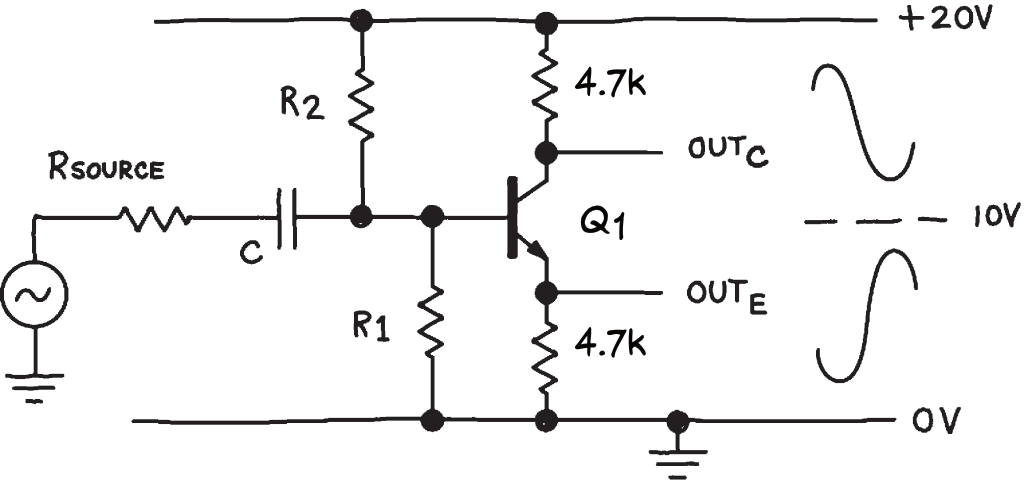
4W.2 Phaser splitter worked example before bias divider calculations
We need to set the voltage at the base of Q1 at ~5V to get the 1mA of quiescent collector current, so the ratio of R2:R1 should be 3:1. The reader asked why in the calculation of the resistor values we use “R” rather than “R1” if we are calculating the value of R1?
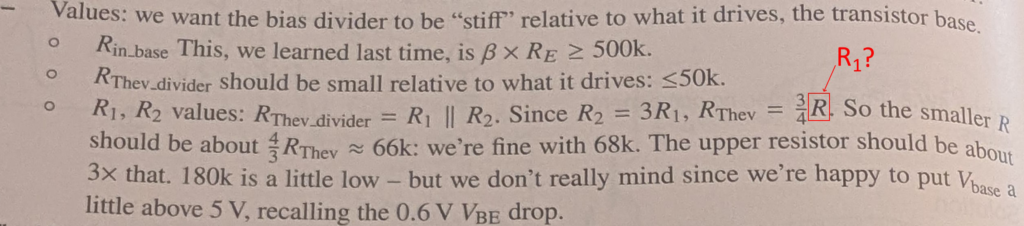
LAoE page 192 calculation of base bias resistive divider for phase splitter
The use of R rather than R1 in the formula for RThev and the description “the smaller R” rather than R1 is deliberate. R1 is only the smaller resistor in this circuit when Q1 is a NPN BJT. You could just as easily build this circuit with a PNP device and it would work as well but then R2 would be the smaller resistor. (Of course the in-phase and out of phase outputs would be reversed with the PNP.)
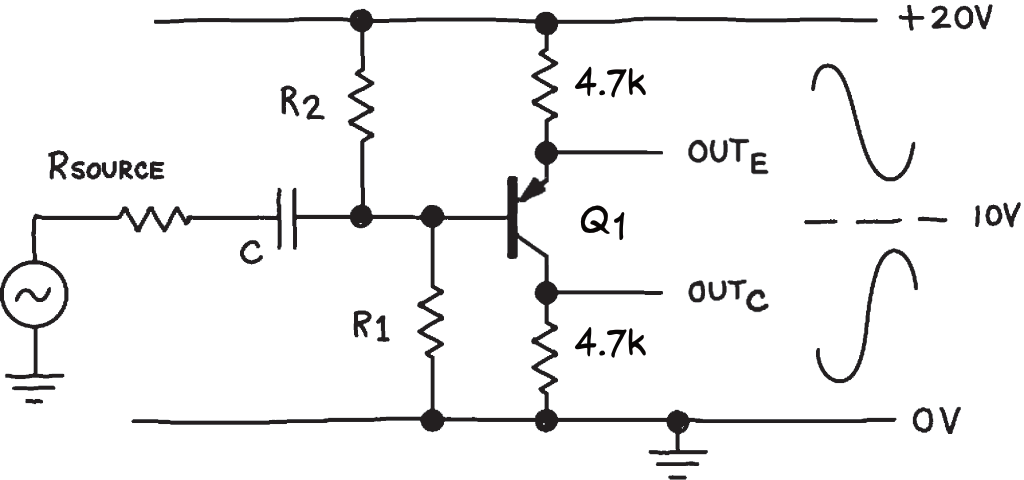
The phase splitter of worked example 4W.2 using a PNP transistor.
In this version, the formula for the Thevenin equivalent resistance of the divider is unchanged but R2 is the smaller resistor. The design description is trying to be non-denominational so you don’t think you need a different calculation for the PNP version.